
The biggest problem I have in editing is that I love adverbs, the word ‘just’ and long run-on sentences. Then there is punctuation just to sweeten the pot a bit more. I’m not sure how anyone else handles these issues. That is why I’m posting this and hoping someone will give me some ideas.
I have developed a four-step process out of necessity and desperation.
Step 1: Microsoft Word Editor. It is a good first pass. It catches many of my punctuation errors, and sometimes gives me options for my word choices.
Step 2: Use Microsoft Review – Read Aloud function. This is a variable speed text-to-voice app that is native to Word. You have choices of male or female voice as well as speed. I keep my mouse on the ‘pause’ button to help me stop and fix things as I hear them. The best part of this, is that it helps with the dialog and the flow.
Step 3: Grammarly. I use the free option and I have it set up on Word. The paid option is more powerful, but I’m not sure the AI driving it is as good as it can be. It does argue a lot with Microsoft Word Editor over punctuation. In the end I have to make the decision and hope I have it done properly.
The first three are relatively simple, but time consuming. They force out the easy mistakes. It does not focus much of grammatical construction errors. I struggle with this adverb use and the annoying habit of using the word ‘just’ too often.
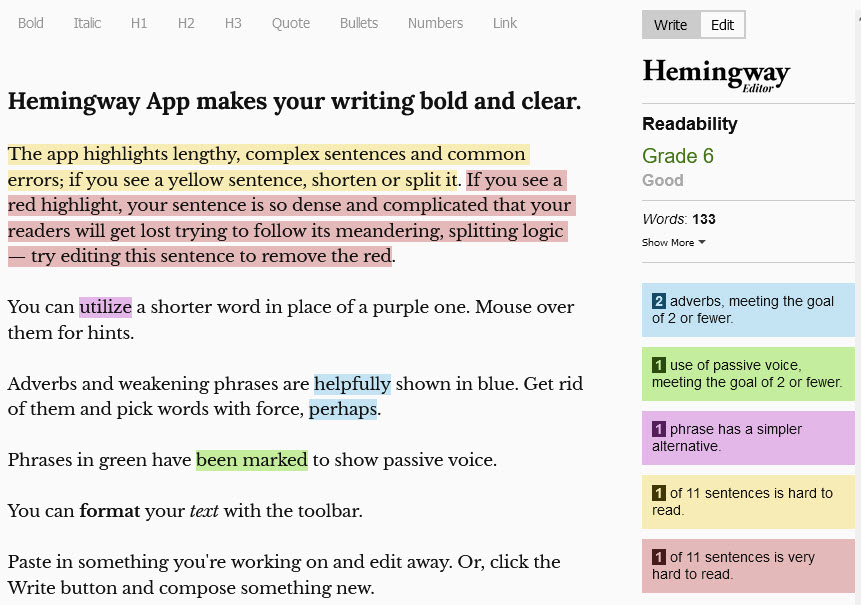
In doing a few searches for a better tool to help me clean up my work, I found Hemingway Editor. This tool is both powerful and annoying. It looks for complex sentences and lists them as hard to read, or very hard to read.
One of the key points of Hemingway’s writing is its simplicity. That is a very deceiving metric. Wordsmiths pride themselves, or at least I do, in how much we can pack into a sentence. The problem is, the more complex the sentence, the harder it is to get the point.
Let’s go back to the basics of storytelling. We have a general arc for the story. We create characters to help move the plot forward. We use sentences and paragraphs to create scenes. The scenes must move the plot forward. If not, then they are useless and make the plot linger aimlessly. The scenes make up chapters and the chapters tell the full story.
If a sentence fails to make the impact necessary, it is a poor sentence. It does not matter how grammatically correct it may or may not be. The Hemingway Editor app points out overly complex grammar. It makes allowances for passive voice, another of my grammatical failures.
Step 4: Hemmingway Editor App helps me rework the scene and keep the content crisp and clean. I run through this almost final step to improve the flow of the scene. When I’m done, I take it back through step 2. I want to hear the new version of the scene and feel the flow. I’ll repeat steps 2 and 4 as often as necessary till I find a good flow that has a crisp grammatical structure.
AUTHOR’S NOTE:
How do you handle editing your own work?
Are there tools out there that can do what I’m doing better?


